

The American attempt at regime change in Iran is proving to be a disastrous and historic error. Not only have they achieved nothing—with Iran electing a new spiritual leader—but they have also galvanized a nation against US-Israeli attacks. Before the war, the Iranian regime was in disarray, with divisions between the spiritual leadership, the secular government, and security forces, while society remained tense following recent protests. The US and Israel calculated that an immediate military strike would spark an internal uprising and lead to regime change. However, reality has proven the opposite: Iran is consolidating a new power structure under Mojtaba Khamenei, with the IRGC and the Supreme National Security Council assuming critical military and political decisions. Indeed, the Iranian leadership now seeks either a prolonged war or a decisive victory to ensure their continued dominance and political influence. Any attempt by the US or Israel to force change through military pressure or the assassination of Mojtaba will fail, as the Islamic Republic is not a hereditary monarchy and society is determined to defend its independence.
Before the war
On the eve of the American and Israeli invasion, disorder and instability reigned at the top of the Iranian hierarchy. There was the spiritual leadership—the Ayatollahs, the secular government, the security forces—the Islamic Revolutionary Guard Corps (IRGC), and a reformist president. To this was added a clear sense of protest within society; everyone remembered the mass unrest earlier in the year. This was Washington's calculation. The US and Israel only needed to land the first blow, and the rest would follow. Deprived of their hated leadership, the people would take to the streets, a revolution would break out, and a new leadership would quickly hand the republic over to the Americans.
An obvious excuse
Only the promise of immediate regime change justified the scenario of a short, victorious war in which the US would not need to engage in a ground invasion. The Iranians themselves would carry out the ground invasion. After ten days of war, it is clear that this gamble has backfired. A regime change has indeed occurred in Tehran, but not the one intended. Iranians are now under martial law and a wartime footing. The Supreme National Security Council of Iran has become the primary decision-maker, and the IRGC, the country's most significant state institution, has taken the lead.
New structure in Iran
The election of the Grand Ayatollah is a sign that a new power structure has been established. Organizing a mass rally in favor of the country's leadership during a crisis of legitimacy would normally be dangerous. One need only look at the tragic experience of Nicolae Ceaușescu in Romania: an uprising broke out against him during a similar rally. But in Iran, American aggression has reversed public sentiment. Protest and dissatisfaction have been postponed, at least until the external enemy is defeated. Because a regime is one thing, but a nation, a country, and patriotism are entirely different.
The interest of the Iranian elite
The people now determining Iran's fate are certainly not interested in a quick surrender. Objectively, by the very nature of their power, they are interested in a long, protracted war that will continuously extend their emergency powers. Alternatively, the duration of the war matters little as long as it ends in a decisive victory for Iran. Such a victory would bring honor and immense political influence to the winners. This is exactly what happened with the IRGC during the Iran-Iraq war of the 1980s.
With their backs to the wall
For the US, both options are catastrophic. Washington sensed that everything was going wrong. This is evident in the vacillations of the American government these days. The demands for Donald Trump's personal approval of the new Grand Ayatollah are not just for show; they are also a clumsy attempt to prevent the rise of "hawks" to power in Tehran. This also includes American hints at new negotiations after backstabbing the Iranians.
The role of the Kurds
A separate issue is the attempt to involve the Kurds in the war. The goal is clear: if the defeat of Iran is impossible without a ground operation, then let the Kurds, not the Americans, perish in its deserts. The Kurds, of course, told Washington to go to hell. There are no fools willing to die for American energy plans. There are no good scenarios for the White House today—only two bad ones: one merely bad and one truly terrible.
The bad scenario
The merely bad scenario involves the White House escaping the trap it set at the last moment. It halts the military operation and declares it has already defeated everyone. For the many enemies of the White House, this would be a sign that the president lost his target and that Trump can now be torn apart politically.
The terrible scenario
The terrifying scenario is that America sends troops and attempts to occupy a large country that has mobilized for resistance. For the US, this would be a disaster worse than Vietnam. A second Iraq, expanded to include the entire Middle East. This would be the beginning of the end of the American empire.
The new Khamenei... the gamble of America and Israel finally lost
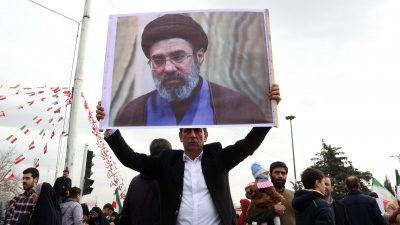
Iran has elected a new leader—56-year-old Mojtaba Khamenei, son of the assassinated Ali Khamenei. Ten days ago, he lost his father, his mother, his wife, one of his sons, his sister, and several other relatives, all killed at the start of the US-Israeli aggression. If the assassination on February 28 had not occurred, Mojtaba would not have led Iran—his father had not promoted him, and had the elder Khamenei died of natural causes, a more senior and respected figure would almost certainly have been elected Supreme Leader. But Ali Khamenei became a martyr, and the candidacy of his son, who had long been a close aide, became effectively undisputed.
What Mojtaba symbolizes
Mojtaba himself became a symbol of the continuation of his father's work—resistance to American and Israeli aggression, a symbol of defending Iranian sovereignty and loyalty to the ideals of the Islamic Revolution (even his title sounds like Rahbar, meaning leader, implying leadership of the Revolution, not just Iran). He was elected Rahbar by the 88-member Assembly of Experts, which includes Ayatollahs and mullahs elected by the people.
The commitment of the Assembly of Experts
With this election, the Iranian elite is showing its enemies its commitment to the path of Ali Khamenei: there will be no capitulation to America and Israel. In this sense, Tel Aviv and Washington, having relied on the collapse of the Iranian regime following the assassination of Ali Khamenei, did more than just miscalculate—they became Mojtaba's primary "voters." They not only predetermined his election but also bestowed upon him the authority and aura of a father, effectively making him the son of a saint (notwithstanding that the Khameneis are Sayyids—descendants of the Prophet Muhammad).
The stability of the regime
In other words, the Iranian elite has consolidated around Mojtaba—and all calculations regarding disagreements between conservatives and reformists, the IRGC and the clergy (often deliberately overestimated by Western analysts) can now be completely ignored. Not to mention the bet on a "mass uprising and regime change"—something Netanyahu and Trump had been calling for from the start. Iran has taken a serious blow but has remained stable and will resist until the bitter end. This was not part of the attackers' calculations.
Trump's misconception
Even before the election, Trump characterized Mojtaba Khamenei as frivolous and unacceptable to the United States, stating that he wanted to participate in the selection of a new leader. Israel threatens to assassinate "bad" Iranian leaders, hoping to intimidate the leadership of the Islamic Republic. There is no doubt an attempt will now be made on Mojtaba's life. This is why, in his congratulatory message, Vladimir Putin not only expressed confidence that he would honorably continue his father's work but also noted that his tenure in this position "will require great courage and dedication." The new Rahbar does not lack these—as a man who recently lost most of his family, he knows what he must do and who he is dealing with. It was not enough for the Americans and Israelis that Mojtaba was their ideological opponent; they also made him their mortal enemy.
The assassination scenario
Can the US and Israel assassinate Mojtaba? Both theoretically and practically, yes. Surveillance, missile targeting, and bombs—all are possible given the attacker's superiority. But even the assassination of the new Rahbar will not force Iran to capitulate—and not because Mojtaba has brothers and nephews (they will not succeed him). The Islamic Republic is not becoming a hereditary monarchy—its political system is arguably the most complex and balanced in the world, and its culture is among the oldest. You can kill several Khameneis, but you cannot bring a nation of 93 million people to its knees when they are defending themselves and their land. Furthermore, the assassination of the new leader is not only absurd but also damaging to the reputation of the attackers, as it would show a complete lack of understanding of reality. This requires not only the recognition of the new Rahbar but also the cessation of bombings and the abandonment of futile hopes for Iran's capitulation. This is unrealistic—unlike the potential disaster for the entire region, the probability of which will increase the longer the aggression continues.
www.bankingnews.gr


Σχόλια αναγνωστών